This is a summary of Forero, A., Pipicelli, F., Moser, S. et. al.,. (2024). Extracellular vesicle-mediated trafficking of molecular cues during human brain development. Published in Cell Reports https://doi.org/10.1016/j.celrep.2024.114755
The challenge
Extracellular vesicles (EVs) are small bubbles released by cells. They act as cargo vessels through which cells exchange signals to communicate with each other. EVs have been the focus of numerous studies on neurodegenerative disorders. However, it has been unknown whether EVs exhibit cell-type-specific features for cellular communication during neurodevelopment. Therefore, we conducted a closer study of the behavior of EVs.
Our approach
To obtain insights into how EVs influence brain development, we used two human brain models: human-induced pluripotent stem cell-derived neural cells in 2d monolayer cultures and cerebral organoids – a 3D model of human brain development.
Our findings
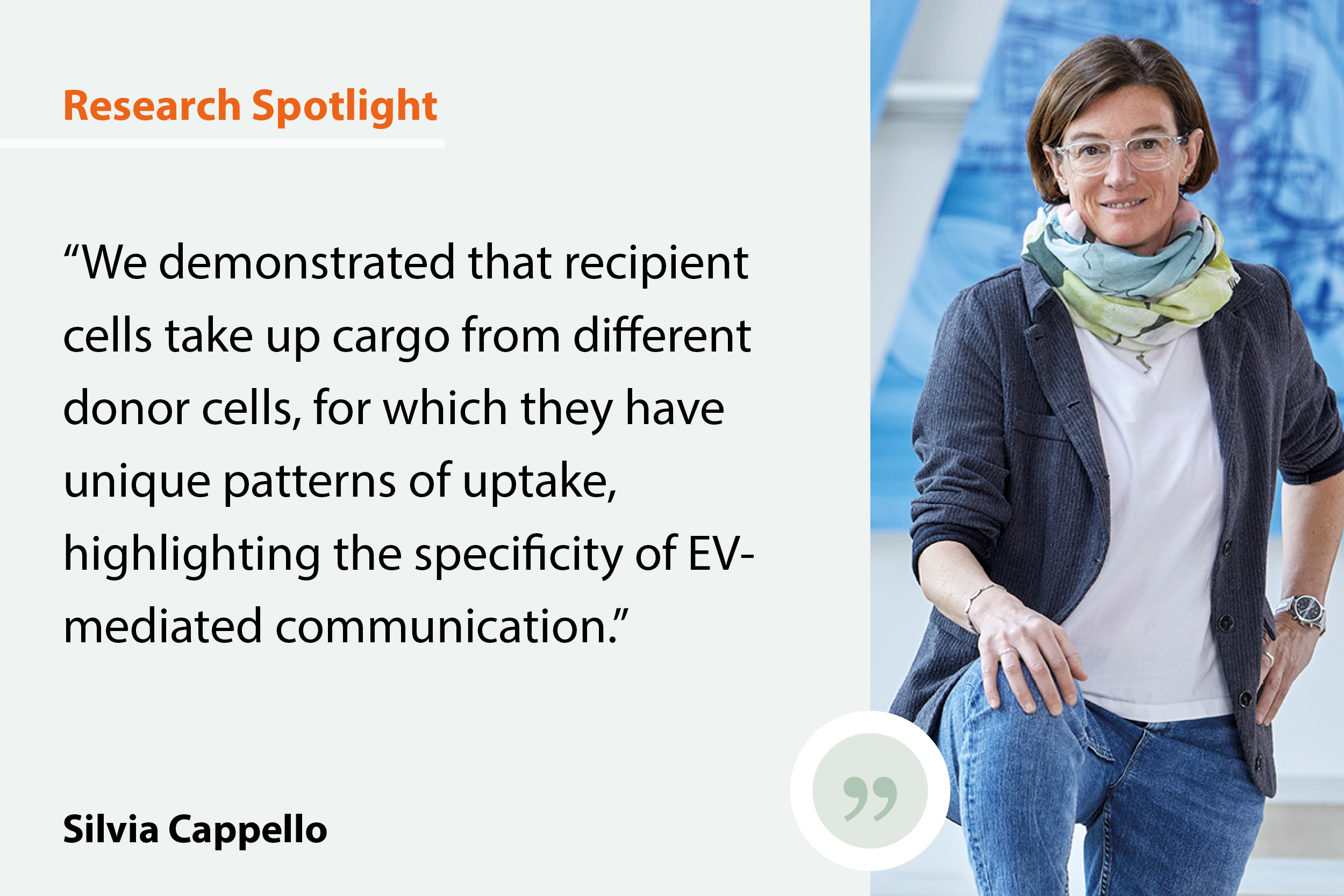
We found that extracellular vesicles play a crucial role in enabling communication between different types of cells. Our research showed that recipient cells take up materials from various donor cells in unique ways, emphasizing the specificity of this mode of communication. We also observed that the protein composition within these vesicles changes as the brain develops and differs across various cell populations and brain regions. This diversity suggests a tightly regulated biogenesis of the vesicles, essential for their specific functions in different cell types.
Furthermore, we discovered that extracellular vesicles can enter the nucleus of neural progenitor cells during cell division, suggesting that they influence important cellular processes in the cytoplasm and at the nuclear level. The cargo transported by these vesicles includes proteins and transcription factors, which are directly transferred to recipient cells, leading to rapid changes in gene expression. One particularly intriguing example is the transcription factor YAP1, which is directly transported to the nucleus of recipient cells and triggers gene expression changes.
Implications
The ability of extracellular vesicles to transport specific molecular signals to the cell nucleus opens up new perspectives for understanding complex cellular interactions in the brain. Overall, our findings underscore the central role of EVs in brain development and could pave the way for new therapeutic approaches for treating neurological diseases in the long term.
Creating SyNergies
The study, led by SyNergy member Silvia Cappello, sheds light on the role of extracellular vesicles in brain development. This research marks a significant step in understanding cellular communication in both neurodevelopmental and neurodegenerative disorders, further advancing SyNergy's mission.