• Zum Hauptinhalt springen
  • Zum Footer springen
  • Deutsch - de
  • English - en

    SyNergy - Mu...

    • Über uns
      • Über uns
      • Maßnahmen
      • Mitglieder
      • Cluster Management
      • PhD und Postdoc-Vertreter
      • Wissenschaftlicher Beirat
      • Internationale Kooperationspartner
      • Timeline
      • Pressekit
      • Kontakt
    • Aktuelles
      • News
      • Veranstaltungen
      • Presseecho
      • Stellenausschreibungen
    • Forschung
      • Publikationen
      • Unser Forschungsschwerpunkt
      • Technology Hubs
      • "Research Spotlight"
      • Management von Forschungsdaten
      • Sustainability Initiative
      • Verhaltenskodex
    • Wissenschaft & Gesellschaft
      • Für Schulen und Schüler
      • Öffentliche Veranstaltungen
      • Podcasts
      • Videos
    • Support für Diversity & Equity
      • Newcomer Center
      • Gender Equality Program
      • Early Career Investigator Programm
    1. Home
    2. Aktuelles
    3. News
    4. Apolipoprotein E aggregation in microglia initiates Alzheimer’s disease pathology by seeding β-amyloidosis
    News | 28/10/2024 | Research Spotlight

    Apolipoprotein E aggregation in microglia initiates Alzheimer’s disease pathology by seeding β-amyloidosis

    The accumulation of amyloid-β plaques is known to initiate a pathological cascade that leads to neurodegeneration and dementia. How these plaques are formed is only partially understood. Researchers provide evidence that aggregation of Apolipoprotein E (APOE) together with amyloid-β within the lysosomal system of microglia may trigger the generation of amyloid-β plaques.
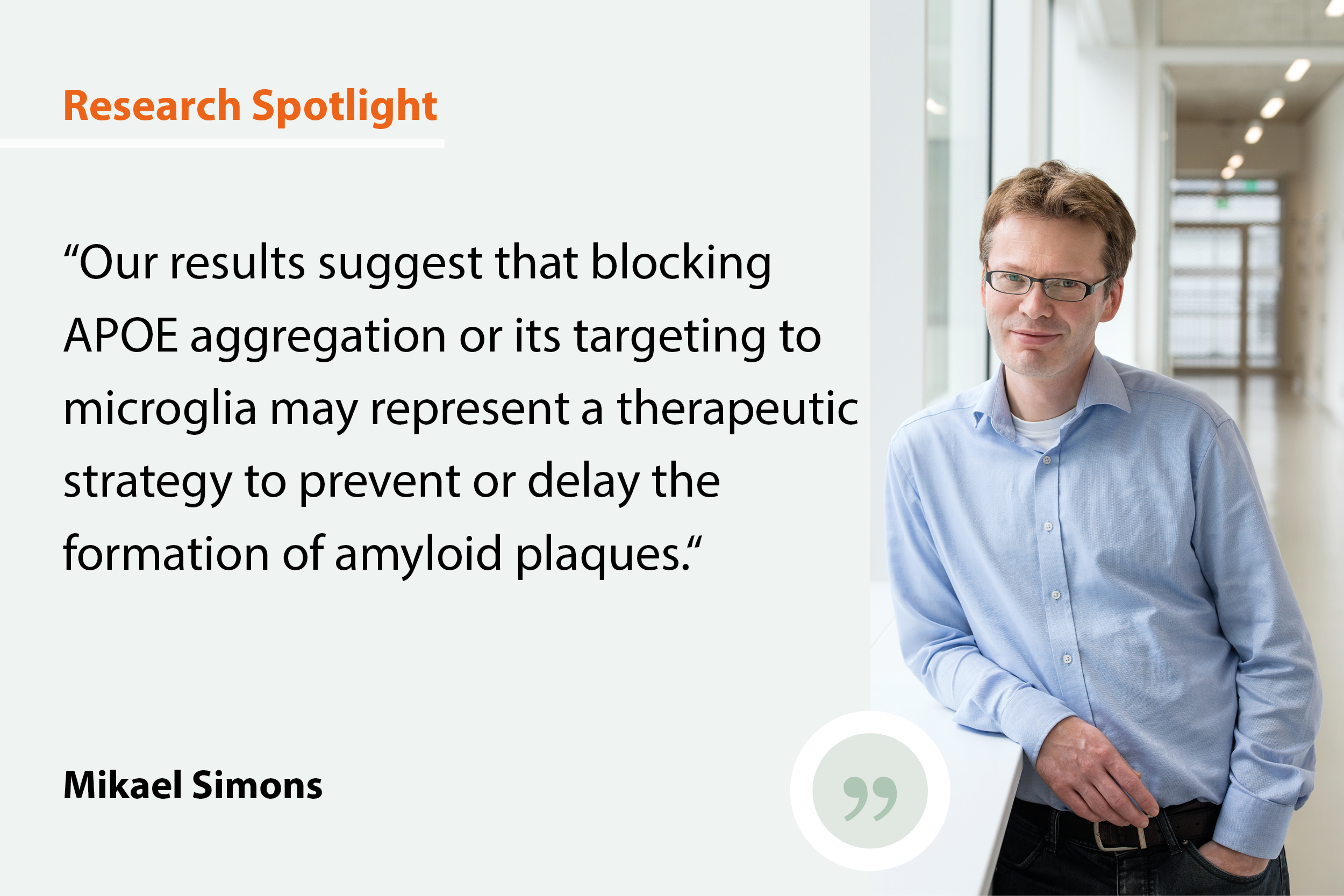
    Research Spotlight: Photo of the researcher and a quote about the impact of the research

    This is a summary of Kaji, S., Berghoff, S., Spieth, L., et al (2024). Apoliprotein E aggregation in microglia initiates Alzheimer’s disease pathology by seeding β-amyloidosis. Published in Immunity https://doi.org/10.1016/j.immuni.2024.09.014


    The challenge

    Alzheimer’s disease (AD) begins with a preclinical phase characterized by the accumulation of insoluble amyloid-β (Aβ), which forms extracellular plaques. This gradual build-up of amyloid plaques is believed to initiate a series of pathological events involving various cell types. These events ultimately lead to neurodegeneration, resulting in a progressive decline in memory and cognitive function. However, how this pathological cascade is initiated is not fully understood. What is known is that the major genetic risk factor for sporadic AD is the APOE4 allele of the Apolipoprotein E (APOE), which was, therefore, the focus of our research.


    Our approach

    Highly sensitive detection and biochemical purification of APOE allowed us to analyze its structure, localization, and function in the initiation and seeding of amyloid aggregates. Specifically, we utilized a new APOE-Halo 5xFAD mouse model that facilitates the visualization and isolation of APOE.


    Our findings

    We isolated APOE aggregates from mouse models of amyloidosis and AD patients. Our study indicates that these fibrillary aggregates of APOE may act as seeds for Aβ plaque formation. This aggregation appears to occur within the lysosomal system of microglia and is linked to cholesterol metabolism. Additionally, lysosomal dysfunction and pro-inflammatory activation contribute to aggregate formation in microglia.


    The implications

    Our results suggest that endocytic uptake and lysosomal aggregation of APOE by microglia can initiate Aβ plaque formation and is modulated by immune and lipid metabolism. Thus, blocking APOE aggregation or its targeting to microglia may represent a therapeutic strategy to prevent or delay the formation of amyloid plaques. Additionally, our study underscores the importance of innate immune mechanisms in the initiation of AD, and provides opportunities for future translational studies in humans.


    Creating SyNergies

    Apart from the lead of this study, Mikael Simons, the Synergy members Sarah Jäkel, Christian Haass, Wolfgang Wurst, and Martina Schifferer were involved in this study and provided resources and technologies.

    Teilnehmende Universitäten
     LMU logo in white
     TUM logo in white
    Partnerinstitute
     Logo DZNE in white
    Helmholtz Munich logo in white 
     Logo Max Planck Gesellschaft 

    SyNergy wird von der Deutschen Forschungsgemeinschaft im Rahmen der deutschen Exzellenzstrategie gefördert (EXC 2145 SyNergy - ID 390857198). Die Exzellenzstrategie fördert herausragende Forschung an deutschen Universitäten. 

    Kontakt

    Munich Cluster for Systems Neurology (SyNergy)

    Feodor-Lynen-Str. 17
    81377 Munich
    +49 (0)89 4400-46497
    yüubgybcјuipxјaGvfulyzemi
    Editor login
    Imprint | Data-Safety