This is a summary of Franzmeier, N., Roemer-Cassiano, S.N., Bernhardt, A.M. et al. Alpha synuclein co-pathology is associated with accelerated amyloid-driven tau accumulation in Alzheimer’s disease. Published in Molecular Neurodegeneration 20, 31 (2025). https://doi.org/10.1186/s13024-025-00822-3
The challenge
Aggregated alpha-Synuclein (αSyn) is a hallmark pathology in Parkinson’s disease and also one of the most common co-pathologies in Alzheimer’s disease (AD). Preclinical studies suggest that αSyn can accelerate tau aggregation, which further drives neurodegeneration and cognitive decline in Alzheimer’s disease. However, this could not be assessed in Alzheimer’s disease patients previously since reliable in vivo biomarkers of αSyn were not available. Recently, a new biomarker has been identified using cerebrospinal fluid (CSF) seed amplification assays (SAA) that quantify the seeding and self-replicative aggregation potential of αSyn seeds in the CSF of patients. This allowed us to test whether αSyn co-pathology accelerates Aβ-driven tau accumulation and cognitive decline.
Our approach
We used the novel CSF-based seed-amplification assay (SAA) to determine αSyn positivity in a large cohort of 592 subjects with available amyloid positron emission tomography (PET) and tau-PET imaging, including 308 cognitively normal individuals (Aβ-negative) and 284 with biomarker-confirmed Alzheimer’s disease pathophysiology (Aβ-positive). A subset of 155 Aβ-positive and 135 Aβ-negative subjects underwent longitudinal tau-PET neuroimaging over approximately 2.5 years. We used linear regression models to analyze our results.
Our findings
We found that alpha-Synuclein co-pathology was associated with elevated amyloid-associated CSF p-tau181 levels, higher tau-PET levels and faster tau-PET increases in AD-typical temporo-parietal brain regions. Furthermore, we found that αSyn co-pathology was related to faster AD-related cognitive decline, which was potentially driven by the faster tau accumulation. These findings suggest that αSyn is a significant modulator of Aβ-associated tauopathy and clinical disease progression in Alzheimer’s disease.
The implications
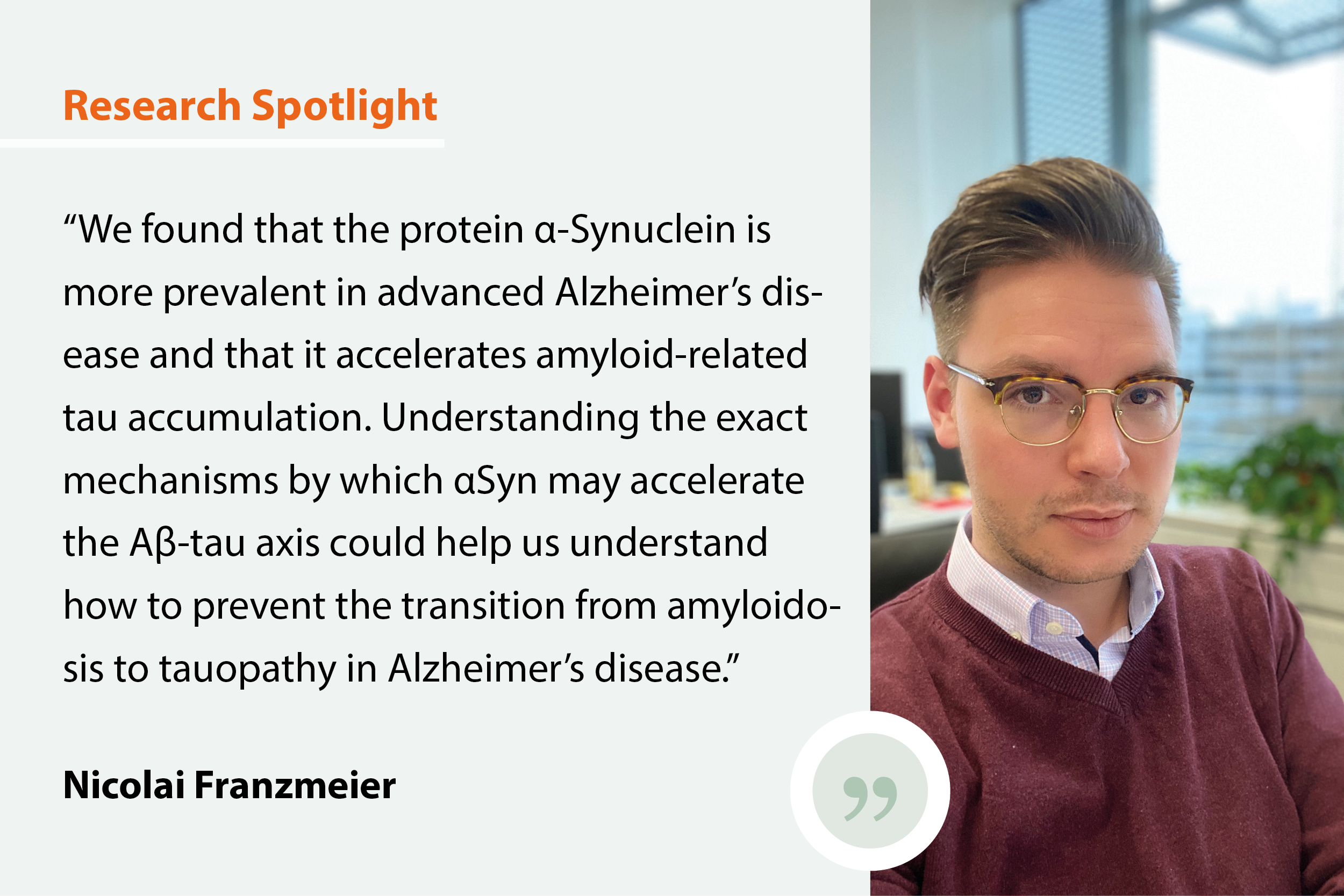
Our findings build upon previous pre-clinical and in vitro studies on the interaction between Aβ, tau, and αSyn. They suggest implications for disease prognosis: the presence of a αSyn co-pathology may further promote the aggregation and spread of tau, contributing to the development of AD dementia. Understanding the exact mechanisms by which αSyn may accelerate the Aβ-tau axis could help us understand how to prevent the transition from amyloidosis to tauopathy in Alzheimer’s disease. Therefore, αSyn co-pathology could be a treatment target in AD.
Creating SyNergies
The study was led by SyNergy member Nicolai Franzmeier who was joined by our members Johannes Levin, Matthias Brendel, and Günter Höglinger.