
• Zum Hauptinhalt springen
  • Zum Footer springen
  • Deutsch - de
  • English - en

    SyNergy - Mu...

    • About
      • About us
      • Our Measures
      • Members
      • Cluster Management
      •  PhD & Postdoc representatives
      • Scientific Advisory Board
      •  International cooperation partners
      • Timeline
      •  Media Kit
      • Contact
    • News & Events
      • News
      • Events
      • In the News
      • Open Positions
    • Research
      • Publications
      • Our Research Focus
      • Technology Hubs
      • Research Spotlight
      • Research Data Management
      • Sustainability Initiative
      •  Code of Conduct
    • Science & Society
      • For Schools & Students
      • Public Events
      • Podcasts
      • Videos
    • Support for Diversity & Equity
      • Newcomer Center
      • Gender Equality Program
      • Early Career Investigator Program
    1. Home
    2. News & Events
    3. News
    4. Urm1 protects proteins in stress situations
    News | 27/06/2024 | Press Release

    Urm1 protects proteins in stress situations

    Scientists at the MPI of Biochemistry show that the protein Urm1 protects other proteins in cellular stress situations by promoting phase separation.
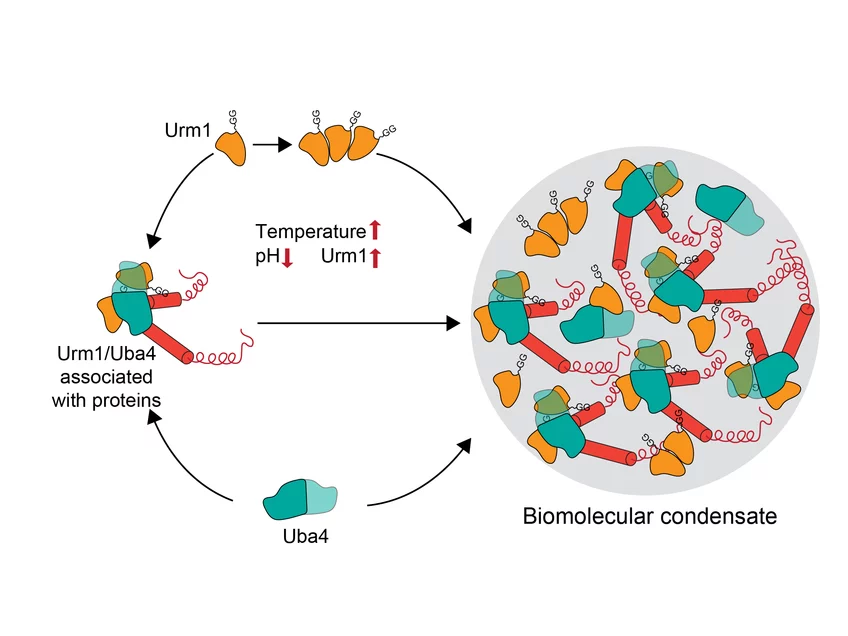
    Illustration adapted from the original publication
    In response to stress, for example, upon temperature increase, cellular pH decreases and the amount of Urm1 increases in cells. Urm1 (orange) self-interacts and associates with other proteins (red) in co-operation with Uba4 (aqua), forming a complex protein interaction network that results in the formation of a biomolecular condensate.  

    To prevent proteins from being damaged during cellular stress, they are concentrated in so-called stress granules. Scientists from the department of Cellular Biochemistry at the Max Planck Institute of Biochemistry have now been able to show for the first time that the protein Urm1 has a critical role in this process. In yeast cells, the ubiquitin-like protein facilitates the onset of phase separation and thus the formation of stress granules. The results of the study were published in the scientific journal Cell.

    • Read the full press release on the website of Max Planck Insitute of Biochemistry

    Participating Universities
     LMU logo in white
     TUM logo in white
    Partner Institutions
     Logo DZNE in white
    Helmholtz Munich logo in white 
     Logo Max Planck Gesellschaft 

    SyNergy is funded by the Deutsche Forschungsgemeinschaft (German Research Foundation) within the framework of the German Excellence Strategy (EXC 2145 SyNergy – ID 390857198). The Excellence Strategy promotes outstanding research at German universities. 

    Contact

    Munich Cluster for Systems Neurology (SyNergy)

    Feodor-Lynen-Str. 17
    81377 Munich
    +49 (0)89 4400-46497
    yüubgybcјuipxјGvfulyzemi
    Editor login
    Imprint | Data-Safety