The challenge
TREM2 is a major Alzheimer’s disease risk pathway and a key driver of the transition from homeostatic microglia to plaque-associated states, yet therapeutic modulation has been difficult. Clinical efforts with agonistic anti-TREM2 antibodies have faced setbacks, highlighting how limited understanding of when and in which microglial state to activate TREM2 can undermine outcomes. A central gap is that microglia are heterogeneous: TREM2 expression varies across cells and across plaque proximity, and that variation may determine metabolic readiness, phagocytic capacity, and responsiveness to agonism. Without tools to resolve TREM2 levels at the single-cell population level in vivo, optimal timing and patient stratification for TREM2 agonists remain uncertain.
Our approach
We created a CRISPR knock-in Trem2-mKate2 reporter (P2A-mKate2-KDEL) enabling FACS separation of microglia into low/mid/high TREM2-expressing subpopulations. We profiled these subsets in healthy and amyloid models using bulk RNA-seq, single-cell radiotracing of [18F]FDG uptake, and LC–MS metabolomics/lipidomics. Finally, we performed chronic in vivo treatment with a blood–brain-barrier–penetrant TREM2 agonist antibody (ATV:4D9) to test expression-dependent therapeutic responsiveness.
Our findings
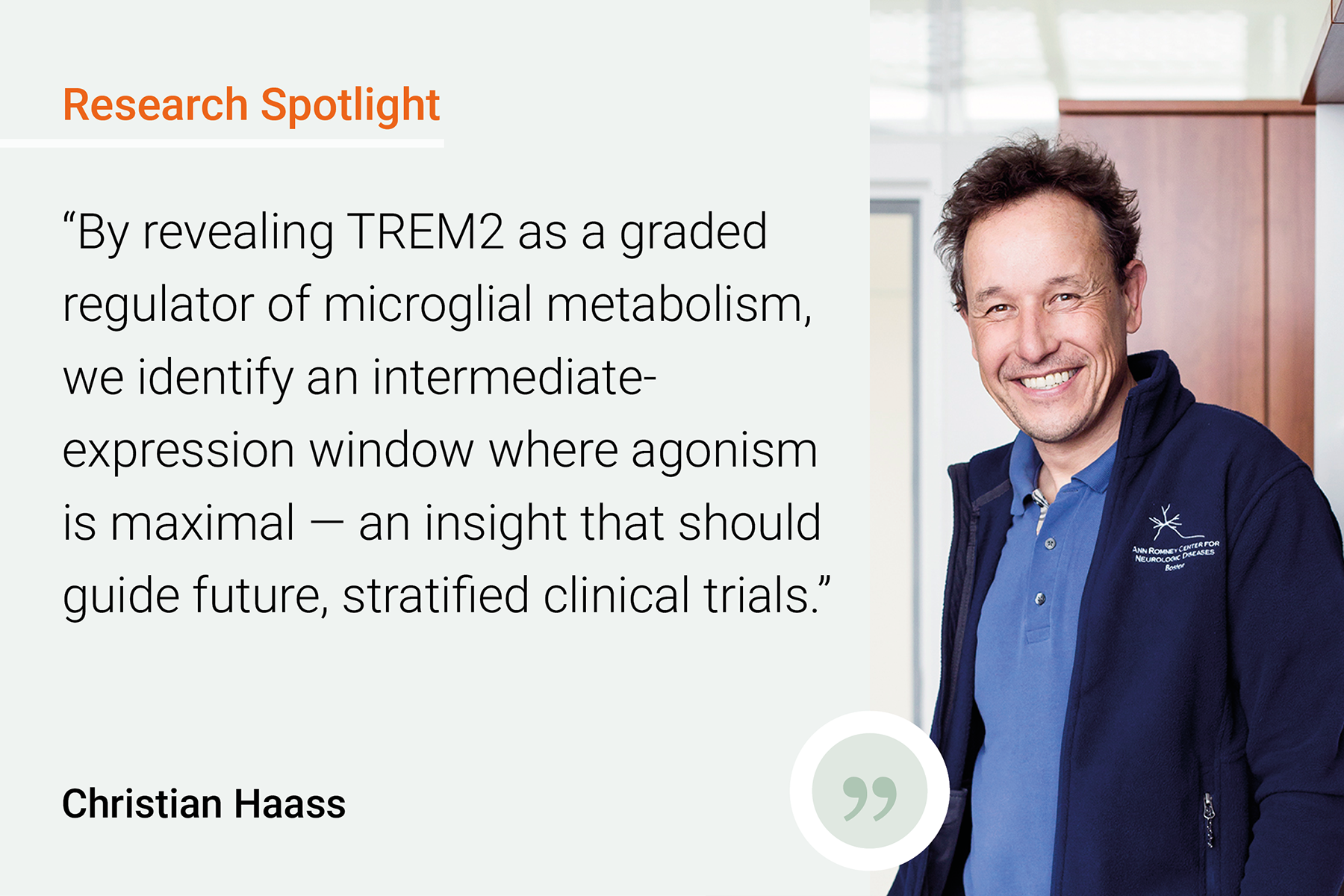
TREM2 expression rose gradually with plaque proximity and delineated distinct microglial transcriptional modules. Across conditions, higher TREM2 tracked with greater glucose uptake and a metabolic/lipidomic shift consistent with higher energetic capacity, increased redox potential (e.g., glutathione-related patterns), and improved cholesterol handling. Functionally, increasing TREM2 correlated with enhanced phagocytic capacity. Importantly, chronic ATV:4D9 dosing produced the strongest metabolic gains in intermediate TREM2 microglia, while high-TREM2 cells showed attenuated or “ceiling-like” responses—defining a window where agonism is most effective.
The implications
Therapeutic TREM2 activation likely requires state-aware timing: microglia with intermediate TREM2 expression may be the most drug-responsive, suggesting patient/stage stratification and longitudinal monitoring of TREM2 could improve trial design and combination strategies with anti-amyloid therapies.
Creating SyNergies
This work exemplifies SyNergy’s systems approach by integrating microglial genetics, single cell radiotracing, and multi-omics to connect molecular state to therapeutic response. It bridges mechanistic neuroimmunology with translational trial-relevant insights—linking microglial heterogeneity to actionable dosing logic. Key SyNergy contributors and senior expertise span metabolism, imaging, and neuroinflammation with SyNergy members Christian Haass, Matthias Brendel, Stefan Lichtenthaler, Mikael Simons, Nikolaus Plesnila, Jonas Neher, and Arthur Liesz.