• Zum Hauptinhalt springen
  • Zum Footer springen
  • Deutsch - de
  • English - en

    SyNergy - Mu...

    • About
      • About us
      • Our Measures
      • Members
      • Cluster Management
      •  PhD & Postdoc representatives
      • Scientific Advisory Board
      •  International cooperation partners
      • Timeline
      •  Media Kit
      • Contact
    • News & Events
      • News
      • Events
      • In the News
      • Open Positions
    • Research
      • Publications
        • Todorov, Mihail
        • Lao, Chu Lan
        • Kopczak, Anna
        • Spitzer, Hannah
        • Groh, Janos
        • Müller, Stephan
        • Schillinger, Ulrike
      • Our Research Focus
      • Technology Hubs
      • Research Spotlight
      • Research Data Management
      • Sustainability Initiative
      •  Code of Conduct
    • Science & Society
      • For Schools & Students
      • Public Events
      • Podcasts
      • Videos
    • Support for Diversity & Equity
      • Newcomer Center
      • Gender Equality Program
      • Early Career Investigator Program
    1. Home
    2. News & Events
    3. News
    4. Synaptic Dopamine Storage Defect Uncovered as Key Mechanism in Parkinson’s Disease Neurons
    News | 14/02/2026 | Research Spotlight

    Synaptic Dopamine Storage Defect Uncovered as Key Mechanism in Parkinson’s Disease Neurons

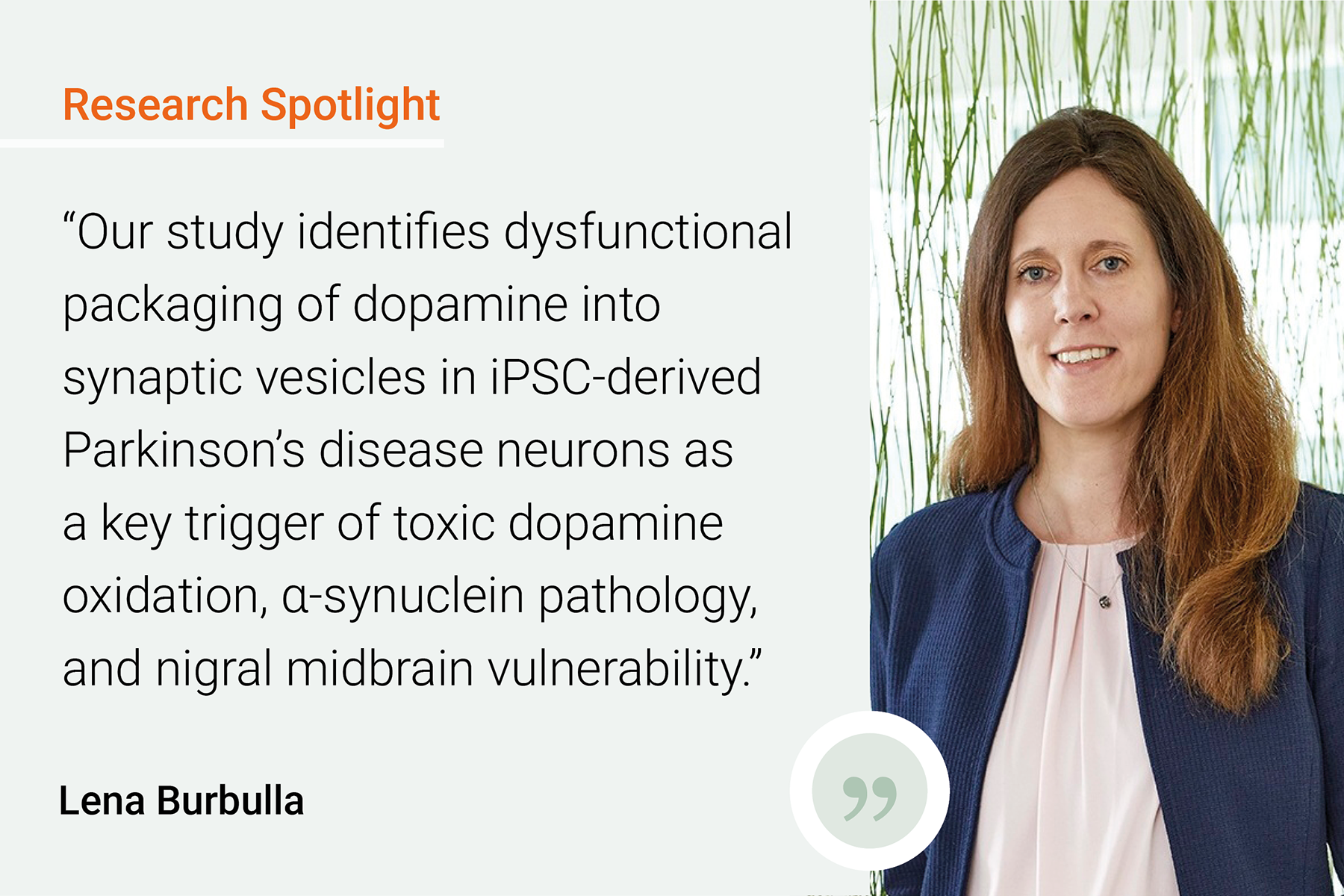
    In this study, dysfunctional vesicular dopamine packaging was uncovered as a central driver of dopamine oxidation and α-synuclein pathology in Parkinson’s disease (PD) neurons. Specifically, in PD-linked induced pluripotent stem cell (iPSC)-derived midbrain dopaminergic neurons lacking the PD-associated protein DJ-1, impaired vesicular monoamine transporter 2 (VMAT2) activity disrupts ATP-dependent dopamine packaging, triggers toxic dopamine oxidation and α-synuclein buildup – revealing a key mechanism in PD.

    This is a summary of Heger et al. VMAT2 dysfunction impairs vesicular dopamine uptake, driving its oxidation and α-synuclein pathology in DJ-1–linked Parkinson’s neurons. Published in Science Advances (2026). DOI: 10.1126/sciadv.adz5645

    The challenge

    PD progressively destroys dopamine neurons in the brain, causing tremors, stiffness, and movement problems. Accumulation of α-synuclein to Lewy bodies and dopaminergic neuron degeneration are central hallmarks with the oxidation of dopamine – turning the neurotransmitter into toxic reactive species – emerging as a key pathological driver. However, the underlying causes of this pathological mechanism in human neurons were unclear.

    Our approach

    Using PD patient-derived and CRISPR-engineered iPSC midbrain dopaminergic neurons lacking the PD-associated gene DJ-1 (PARK7), we applied in-depth proteomics, state-of-the-art imaging, and ultrasensitive dopamine probes to dissect vesicular dopamine handling and homeostasis. Importantly, loss of DJ-1 function – associated with mitochondrial dysfunction and lack of ATP – is implicated in the more common sporadic form of PD beyond rare mutations.

    Our findings

    Dysfunction of vesicular monoamine transporter 2 (VMAT2) – the key transporter responsible for packaging dopamine into synaptic vesicles – impairs the ATP-dependent uptake of dopamine into synaptic vesicles, causing oxidation of dopamine, reduced vesicle availability, abnormal vesicle morphology, and α-synuclein accumulation. ATP supplementation fully restored vesicular function and alleviated dopamine-related pathologies in diseased neurons.

    The implications

    This ATP-sensitive VMAT2 mechanism links loss of DJ-1 and mitochondrial dysfunction to dopamine oxidation and synaptic failure, revealing enhanced dopamine sequestration as a promising disease-modifying strategy. The human iPSC platform opens avenues for targeted therapies preserving synaptic vesicle integrity in PD.

    Creating SyNergies

    This work integrates expertise across SyNergy labs specializing in iPSC disease modeling, advanced proteomics, and state-of-the-art imaging. Our study therefore highlights how interdisciplinary neurodegeneration research accelerates translation. Key contributing SyNergy researchers include Wolfgang Wurst, Stefan Lichtenthaler, Martina Schifferer and Christian Behrends, whose combined expertise bridges mechanism, modeling, and intervention.

    Participating Universities
     LMU logo in white
     TUM logo in white
    Partner Institutions
     Logo DZNE in white
    Helmholtz Munich logo in white 
     Logo Max Planck Gesellschaft 

    SyNergy is funded by the Deutsche Forschungsgemeinschaft (German Research Foundation) within the framework of the German Excellence Strategy (EXC 2145 SyNergy – ID 390857198). The Excellence Strategy promotes outstanding research at German universities. 

    Contact

    Munich Cluster for Systems Neurology (SyNergy)

    Feodor-Lynen-Str. 17
    81377 Munich
    +49 (0)89 4400-46497
    yüYubgybc,јuYipnxј_vfulyzemi
    Editor login
    Imprint | Data-Safety | Accessibility