• Zum Hauptinhalt springen
  • Zum Footer springen
  • Deutsch - de
  • English - en

    SyNergy - Mu...

    • About
      • About us
      • Our Measures
      • Members
      • Cluster Management
      •  PhD & Postdoc representatives
      • Scientific Advisory Board
      •  International cooperation partners
      • Timeline
      •  Media Kit
      • Contact
    • News & Events
      • News
      • Events
      • In the News
      • Open Positions
    • Research
      • Publications
        • Todorov, Mihail
        • Lao, Chu Lan
        • Kopczak, Anna
        • Spitzer, Hannah
        • Groh, Janos
        • Müller, Stephan
        • Schillinger, Ulrike
      • Our Research Focus
      • Technology Hubs
      • Research Spotlight
      • Research Data Management
      • Sustainability Initiative
      •  Code of Conduct
    • Science & Society
      • For Schools & Students
      • Public Events
      • Podcasts
      • Videos
    • Support for Diversity & Equity
      • Newcomer Center
      • Gender Equality Program
      • Early Career Investigator Program
    1. Home
    2. News & Events
    3. News
    4. Single-synapse mechanisms shape visual perception
    News | 01/04/2026 | Research Spotlight

    Single-synapse mechanisms shape visual perception

    Understanding how the brain processes visual information requires resolving synaptic activity at the finest scale. This study reveals how thalamic inputs to the primary visual cortex operate at individual synapses and demonstrates that they fundamentally differ from intracortical connections, validating a long-standing theoretical model of sensory processing.

    This is a summary of Chen et al. Thalamic activation of the visual cortex at the single-synapse level Published in Science (2026) DOI: 10.1126/science.aec9923

    The challenge

    A central question in neuroscience is how neurons in the primary visual cortex (V1) become selective for specific stimulus orientations. Classical models, proposed by Hubel and Wiesel, suggest that this selectivity emerges from the spatial alignment of thalamic inputs. However, experimental evidence has remained conflicting, particularly in mice, where some studies suggested that orientation selectivity might already be present in thalamic inputs themselves. Resolving this controversy requires direct observation of synaptic activity at the level of individual inputs onto cortical neurons during sensory processing. Yet, technical limitations have historically prevented distinguishing thalamocortical from corticocortical inputs with sufficient spatial and functional precision in vivo.

    Our approach

    We combined in vivo two-photon glutamate and calcium imaging with optogenetic cortical silencing to identify and functionally characterize individual synapses onto layer 4 neurons in mouse V1. This allowed us to directly distinguish thalamocortical from intracortical inputs and map their functional properties at single-spine resolution.

    Our findings

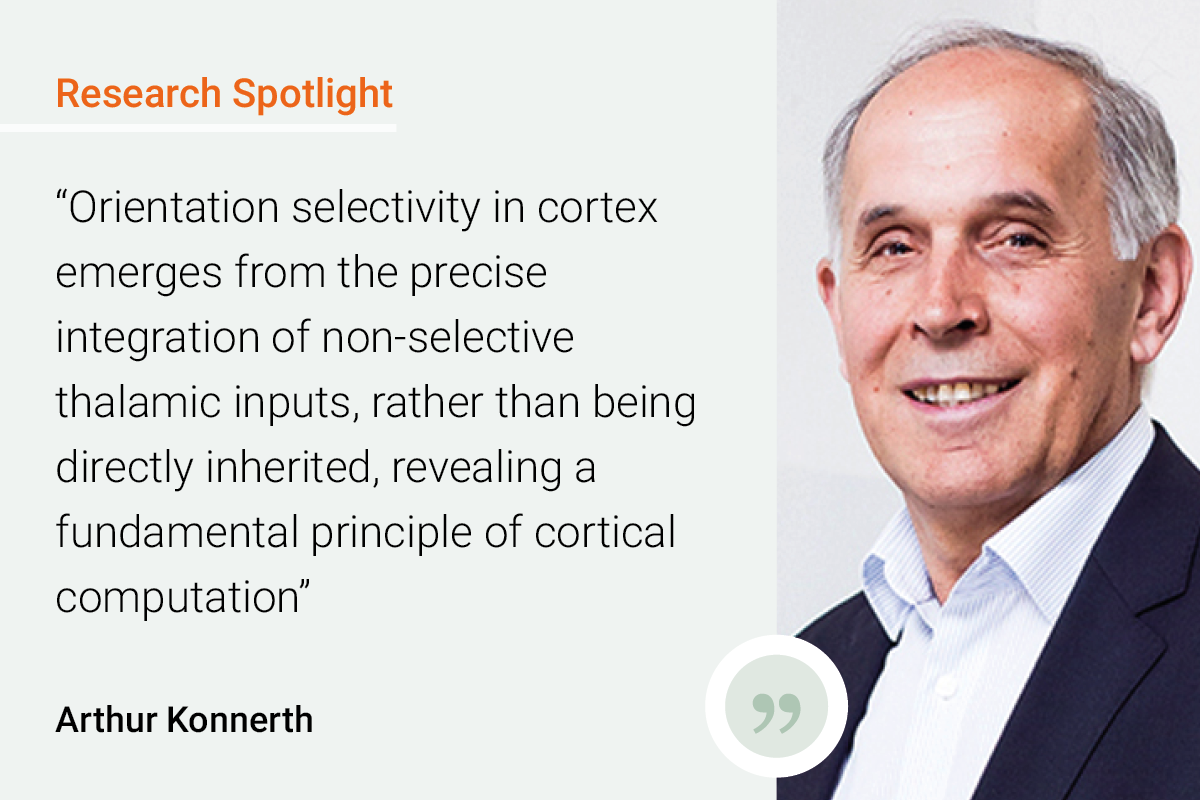
    We discovered that thalamocortical synapses provide largely non–orientation-selective input and, strikingly, do not evoke postsynaptic calcium signals. In contrast, corticocortical synapses showed strong orientation tuning and robust calcium responses. These results demonstrate that orientation selectivity is not inherited from thalamic inputs but emerges within cortical circuits. Importantly, the spatial arrangement of thalamic inputs matched the predictions of the classical feedforward model, providing direct experimental validation at the synaptic level.

    The implications

    These findings redefine how sensory information is transformed in the cortex and highlight distinct synaptic mechanisms underlying cortical computation and plasticity.

    Creating SyNergies

    By integrating advanced imaging, optogenetics, and circuit-mapping approaches, this study bridges systems neuroscience and synaptic physiology. It provides a mechanistic link between classical theoretical models and modern experimental evidence. The work of Arthur Konnerth and team exemplifies how interdisciplinary strategies can resolve long-standing debates and advance our understanding of cortical computation.

    Participating Universities
     LMU logo in white
     TUM logo in white
    Partner Institutions
     Logo DZNE in white
    Helmholtz Munich logo in white 
     Logo Max Planck Gesellschaft 

    SyNergy is funded by the Deutsche Forschungsgemeinschaft (German Research Foundation) within the framework of the German Excellence Strategy (EXC 2145 SyNergy – ID 390857198). The Excellence Strategy promotes outstanding research at German universities. 

    Contact

    Munich Cluster for Systems Neurology (SyNergy)

    Feodor-Lynen-Str. 17
    81377 Munich
    +49 (0)89 4400-46497
    yüubgybDcјuipxјhdvfulyzemi
    Editor login
    Imprint | Data-Safety | Accessibility