The Challenge
Brain development requires tight coordination between cytoskeletal remodeling and gene regulation. While cytoskeletal proteins are traditionally associated with structural functions in the cytoplasm, increasing evidence suggests that some may also act in the nucleus. However, a comprehensive understanding of nuclear cytoskeletal proteins and their role in neural stem cells has been lacking. This gap is particularly relevant for neurodevelopmental disorders such as periventricular heterotopia (PH), where mutations in cytoskeletal proteins cause abnormal neuronal positioning. The molecular mechanisms linking these mutations to altered neural stem cell behavior and disease remain poorly understood.
Our Approach
We combined nuclear-cytoplasmic fractionation with quantitative proteomics in human and mouse neural stem cells to identify proteins present in both compartments. We then investigated MAP1B using molecular, cellular, transcriptomic, imaging, and organoid-based approaches, including disease-associated patient mutations and chromatin-binding analyses.
Our Findings
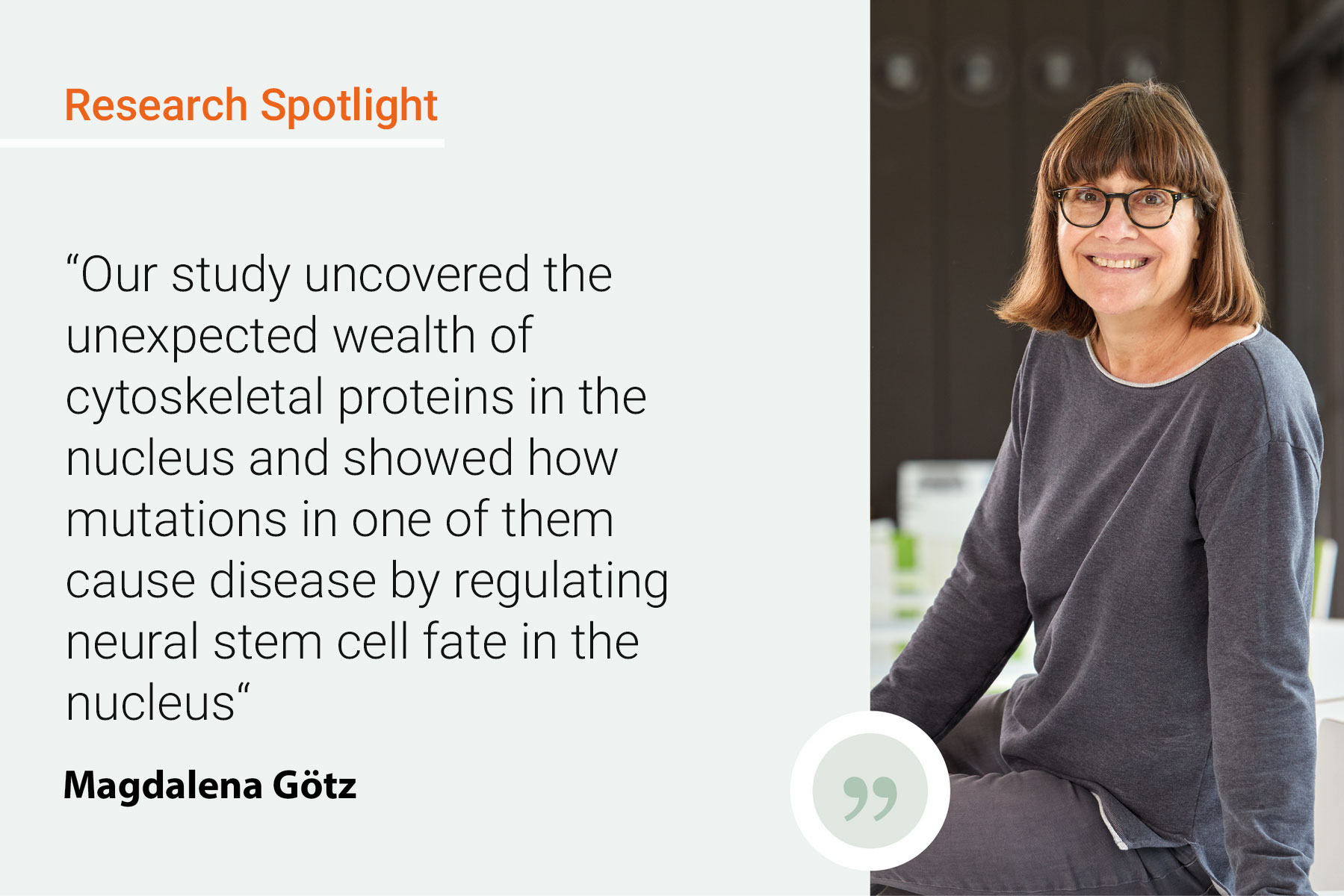
The study uncovered a substantial nuclear pool of cytoskeletal proteins and identified MAP1B as a critical regulator of neural stem cell fate. MAP1B shuttles between the cytoplasm and nucleus, where it interacts with the BRG1-containing BAF chromatin-remodeling complex. Nuclear MAP1B promotes stem cell maintenance, whereas cytoplasmic MAP1B supports neuronal differentiation. Disease-associated MAP1B mutations increase nuclear enrichment of the protein, enhance BRG1 chromatin occupancy, and lead to neuronal ectopia in mouse models and human brain organoids, providing a mechanistic link to neurodevelopmental disease.
The Implications
These findings reveal an unexpected nuclear role for a cytoskeletal protein and show how altered MAP1B localization can reshape chromatin regulation, neural stem cell fate, and neurodevelopmental disease mechanisms.
Creating SyNergies
This work combines expertise in stem cell biology, proteomics, chromatin regulation, neurodevelopment, advanced imaging, and disease modeling. By integrating human iPSC-derived neural stem cells, brain organoids, mouse models, and multi-omics approaches, the study uncovers a previously unrecognized mechanism linking cytoskeletal dynamics to gene regulation during brain development. Authors: Florencia Merino, Silvia Cappello, Magdalena Götz.