The challenge
In Alzheimer’s disease and related tauopathies, phosphorylated Tau can accumulate years before clear cognitive symptoms appear. At the same time, reduced glucose metabolism in the brain is one of the strongest predictors of future decline. Yet it remained unclear how these two features interact to cause actual neuronal loss. The central question was whether glucose hypometabolism merely marks vulnerable brain regions or actively drives degeneration together with p-Tau.
Our approach
We combined neuronal cell models, primary neurons, Tau transgenic mice, human Alzheimer’s brain tissue, imaging, biochemical assays, and intervention experiments. We tested how low-glucose conditions affect neurons carrying pathological Tau and examined whether blocking RIPK1 signaling, restoring A20, or disrupting p-Tau–RIPK1 binding could prevent neuronal death.
Our findings
Low glucose did not simply stress neurons in general; it specifically triggered necroptosis in neurons containing pathological p-Tau. Mechanistically, p-Tau recruited RIPK1 and promoted necroptotic signaling, while glucose hypometabolism reduced A20, removing an important brake on this pathway. Restoring A20 with acetyl-L-carnitine or blocking the p-Tau–RIPK1 interaction protected Tau mice from neuronal loss, brain atrophy, and memory impairment.
The implications
The findings reveal a metabolic trigger of Tau-related neurodegeneration and suggest that combined p-Tau and FDG-PET imaging may help identify patients most likely to benefit from necroptosis-targeted therapies.
Creating SyNergies
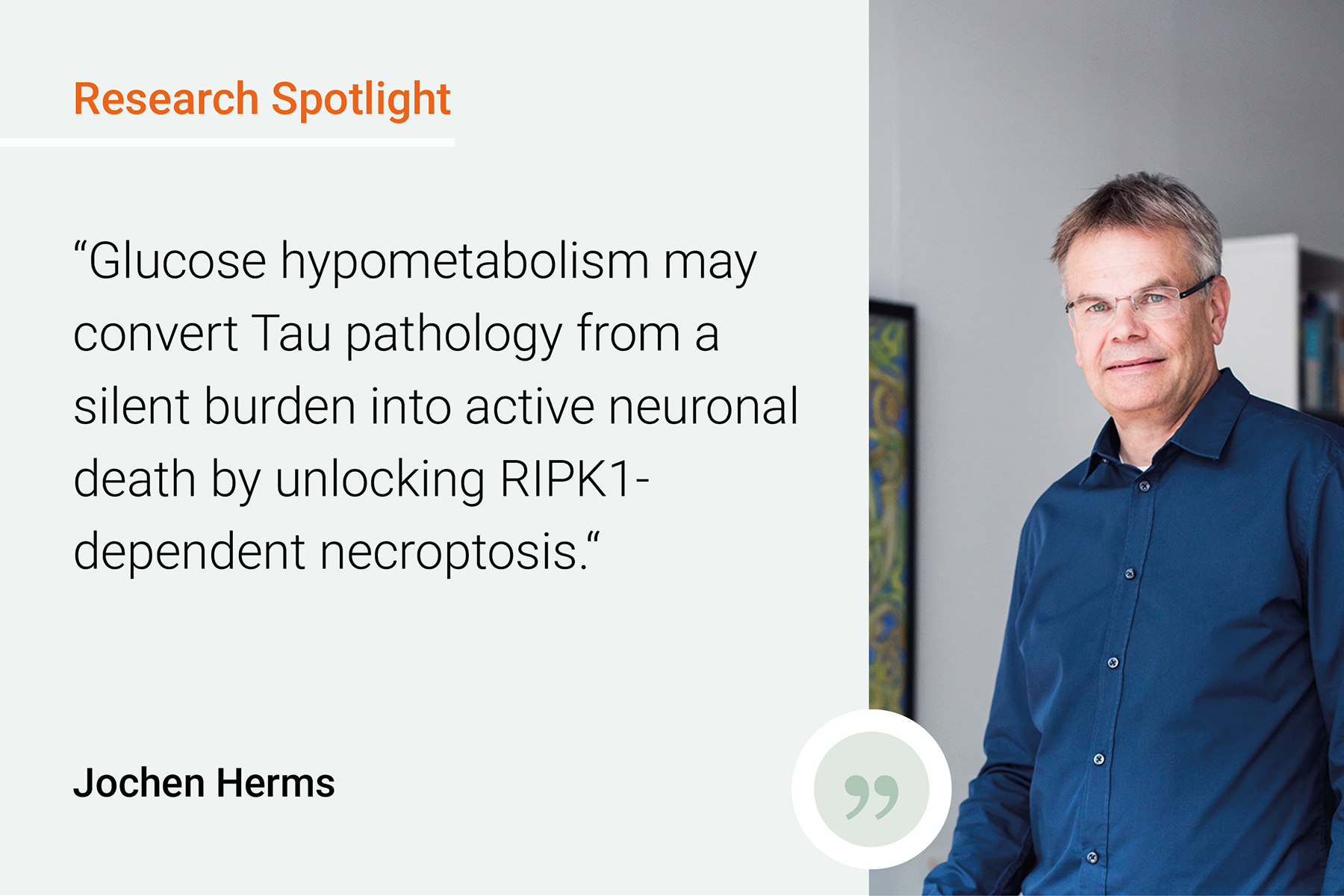
With contributions from SyNergy members Matthias Brendel and Jochen Herms, this work connects molecular neurodegeneration, imaging, metabolism, and translational disease modeling. It highlights how SyNergy-based expertise can bridge mechanisms seen in cells and mice with patterns observed in human Alzheimer’s disease, opening new routes for patient stratification and therapeutic development.