The challenge
Neurons are particularly dependent on mitochondria to meet their high energy demands. Given the complex architecture of neurons and their long cellular processes, maintaining healthy mitochondria far away from the cell body poses a particular challenge. The protein PINK1 plays a central role in detecting mitochondrial damage and initiating the selective removal of damaged mitochondria, a process called mitophagy. Mutations in the gene encoding PINK1 cause hereditary Parkinson’s disease.
We previously showed that neurons transport PINK1 messenger RNA (mRNA) along mitochondria to ensure local protein supply. However, where PINK1 is produced and how it reaches mitochondria remained unclear. We therefore investigated how the local production and delivery of PINK1 are regulated and how these processes affect mitochondrial quality control.
Our approach
We developed a fluorescence-based reporter system that allowed us to visualize the production and movement of PINK1 in living neurons. By combining live-cell imaging, correlative light and electron microscopy, cryo-electron tomography, and molecular biology techniques, we investigated the interplay between different cellular compartments. We used cultured mouse neurons as well as human induced pluripotent stem cell-derived neurons.
Our findings
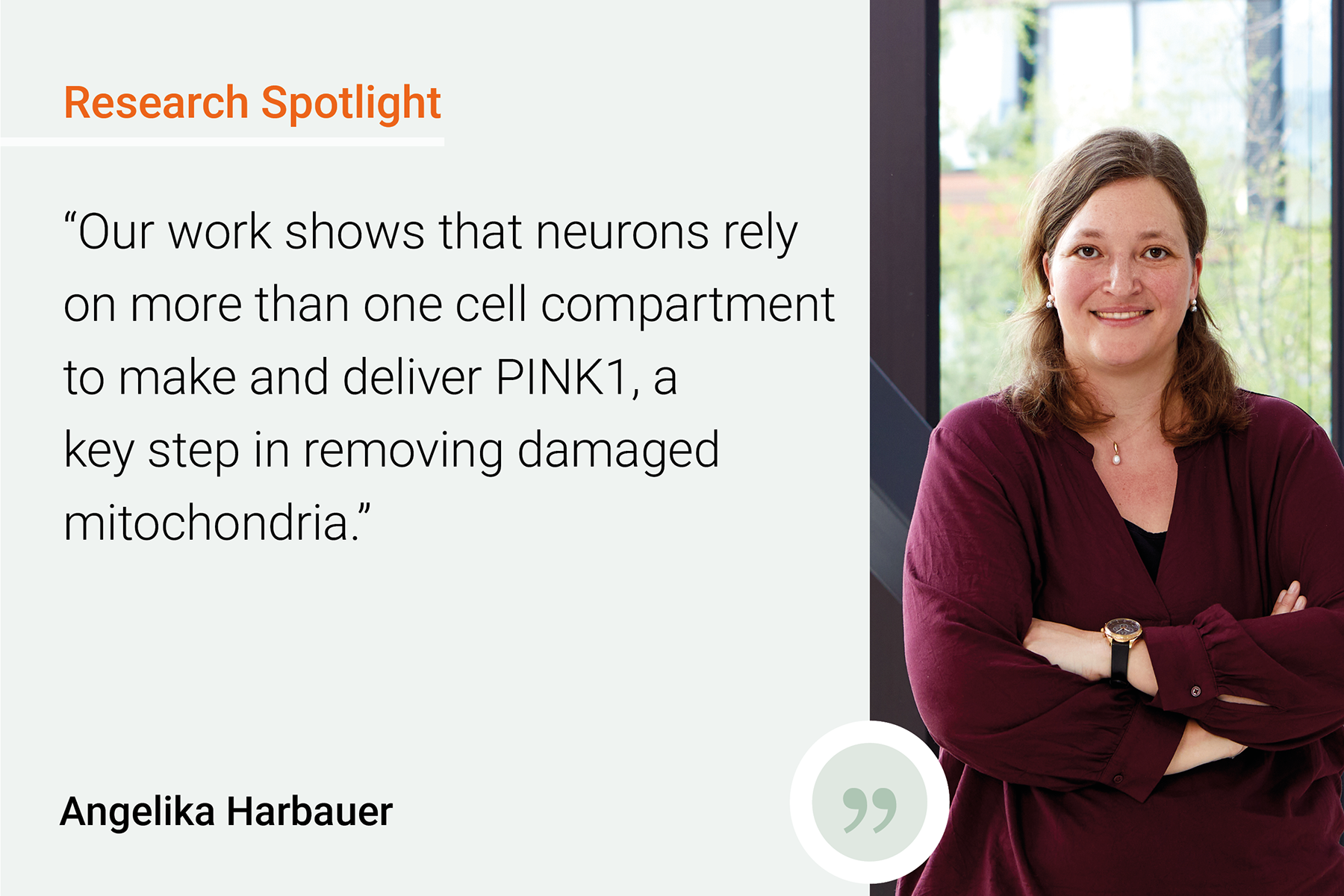
We found that neurons can switch between two pathways of PINK1 production and delivery depending on their metabolic state. PINK1 is either produced directly at mitochondria or synthesized near the endoplasmic reticulum and endolysosomes. In the latter pathway, the chaperone DNAJB6 facilitates the transfer of newly synthesized PINK1 to mitochondria. Reducing DNAJB6 levels impaired the delivery of PINK1 to damaged mitochondria and their subsequent removal, despite ongoing PINK1 production.
The implications
Our findings reveal an unexpected role of the endoplasmic reticulum in neuronal mitochondrial quality control and may open new avenues for investigating mitochondrial dysfunction in Parkinson’s disease and developing strategies to improve mitochondrial health.
Creating SyNergies
The study brought together our members Martina Schifferer, Thomas Misgeld, and Angelika Harbauer, combining complementary expertise in mitochondrial biology, neuronal cell biology, and advanced imaging. In particular, the integration of live-cell imaging with electron microscopy and cryo-electron tomography was instrumental in revealing how different cellular compartments cooperate to maintain mitochondrial health in neurons.