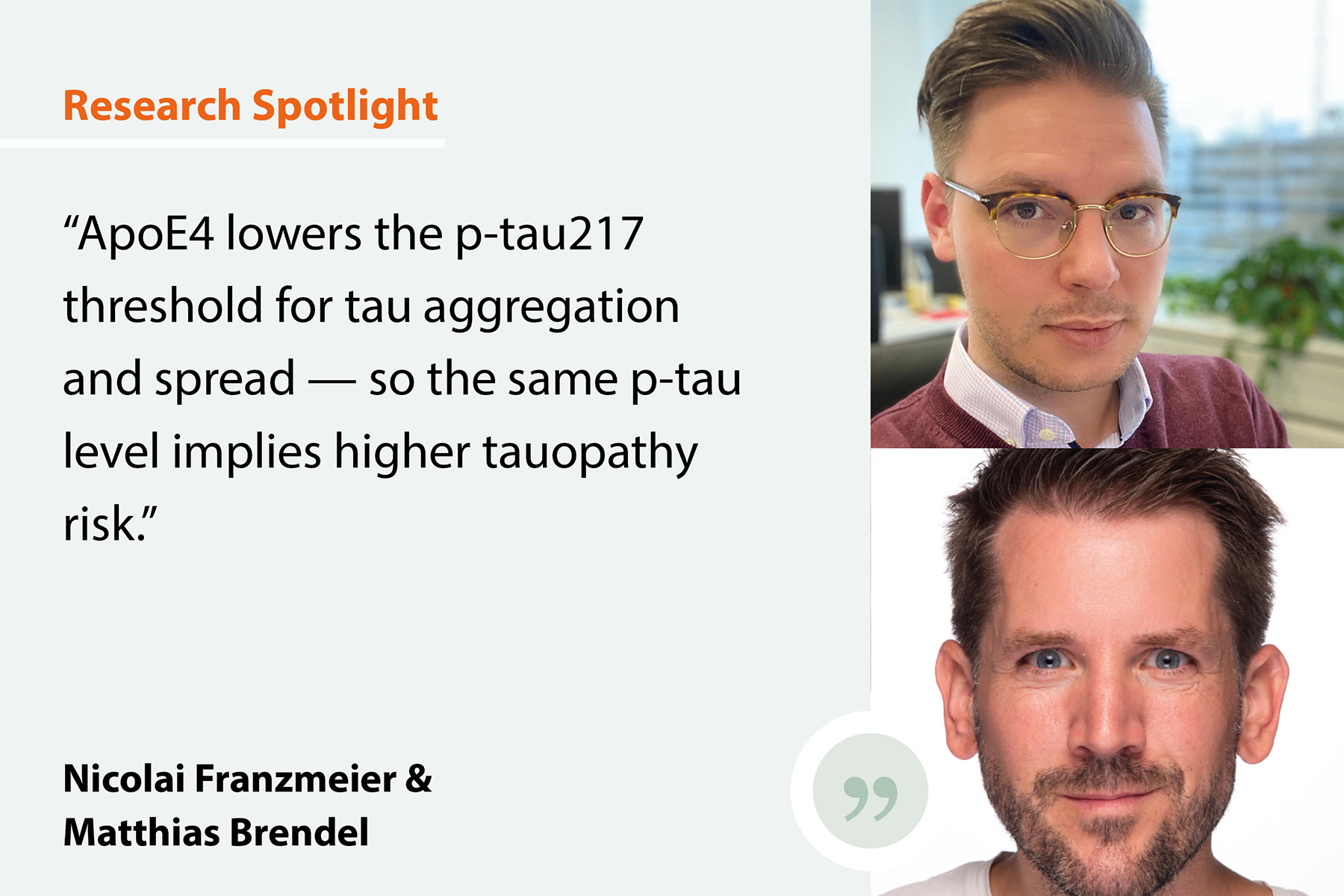
This is a summary of Anna Steward et al. ApoE4 lowers the ptau217 threshold for tau 1 aggregation and spread in an allele dose-2 dependent manner. Published in Brain (2025). DOI: 10.1093/brain/awaf463
The challenge
Alzheimer’s disease unfolds in stages: amyloid-β accumulates first, followed by the emergence and spread of fibrillar tau, which closely precedes neurodegeneration and cognitive decline. ApoE4—the strongest genetic risk factor for sporadic Alzheimer’s disease—is linked to faster tau accumulation at lower amyloid levels, but the mechanism has remained uncertain. One key intermediate is phosphorylated tau (ptau), measurable in plasma and CSF, which rises early with amyloid and is thought to promote downstream tau aggregation. The unresolved question is whether ApoE4 accelerates progression by increasing amyloid-driven ptau secretion (more soluble ptau) or by lowering the threshold at which existing ptau triggers tau aggregation and spread (greater vulnerability)
Our approach
The team analysed two large, APOE-genotyped cohorts (ADNI and A4-LEARN) combining baseline amyloid-PET with plasma p-tau217 (and CSF p-tau181 in a subset) and longitudinal tau-PET. Using connectivity-informed, patient-tailored tau spreading stages, they tested whether ApoE4 moderated (i) amyloid-to-ptau associations or (ii) ptau-to-tau accumulation and propagation. They also derived ApoE4-stratified plasma p-tau217 thresholds indicating early abnormal tau-PET change.
Our findings
ApoE4 did not strengthen the relationship between amyloid-PET and ptau increases, suggesting amyloid-related ptau secretion is largely genotype-independent. In contrast, higher ApoE4 allele count significantly amplified the association between plasma p-tau217 and faster tau-PET spread from individual epicentres across connected regions—independent of amyloid burden. Importantly, ApoE4 lowered the p-tau217 thresholds marking transition to early tauopathy (e.g., in ADNI: 0/1/2 ε4 alleles ≈ 0.62/0.34/0.15 pg/ml; assay-dependent).
The implications
The same plasma p-tau217 value signals higher tauopathy risk in ApoE4 carriers than in non-carriers. Blood-based screening and trial enrolment may require genotype-adjusted thresholds, and ApoE4 carriers may benefit from earlier anti-amyloid intervention, before tau aggregation accelerates.
Creating SyNergies
By integrating genetics, blood/CSF biomarkers, amyloid- and tau-PET, and network-based modelling of disease propagation, the study connects mechanism to clinically actionable biomarker strategy. It highlights how systems-neurology approaches can refine precision screening and therapeutic timing in Alzheimer’s disease. The work reflects SyNergy’s interdisciplinary collaboration across imaging, neurology, and biomarker researchers within SyNergy.