This is a summary of Gasperi, C., Wiltgen, T., McGinnis, J., Cerri, S., Moridi, T., Ouellette, R., Pukaj, A., Voon, C., Bafligil, C., Lauerer, M., Andlauer, T.F.M., Held, F., Aly, L., Shchetynsky, K., Stridh, P., Harroud, A., Wiestler, B., Kirschke, J.S., Zimmer, C., Baras, A., Piehl, F., Berthele, A., Granberg, T., Kockum, I., Hemmer, B. and Mühlau, M. (2023), A Genetic Risk Variant for Multiple Sclerosis Severity is Associated with Brain Atrophy. in Annals of Neurology. https://doi.org/10.1002/ana.26807
The challenge
Despite the successes of multiple sclerosis (MS) immune therapies that reduce and halt MS relapses, the treatment of its progression remains a challenge. The determinants of disease severity and long-term outcomes of MS are largely unknown. In a recent genome-wide association study, two MS “severity genes” that are associated with a more severe progression of MS were identified: among them, the minor allele of the single nucleotide polymorphism rs10191329 in the DYSF-ZNF638 locus. Its relation to neuron loss (brain atrophy) was, however, unclear. Brain atrophy occurs in all people as they age but happens more quickly in people with MS. It is a reliable predictor of future physical and cognitive disability. In this new study, we therefore studied the gene variant’s relation to brain atrophy.
Our approach
The study included people with relapsing MS from Germany and Sweden. For each participant the presence or absence of the “MS severity gene”, as identified in the previous study, was established. Subsequently, magnetic resonance imaging (MRI) was used to measure the loss of neurons. To ensure the reliability of our study, we included a replication cohort with the same analyses to determine whether the association between the genetic variant and brain atrophy could be consistently replicated.
Our findings
We found that the severity gene results in higher brain atrophy rates: we found 28% more brain atrophy in people with the MS severity gene than those without.
The implications
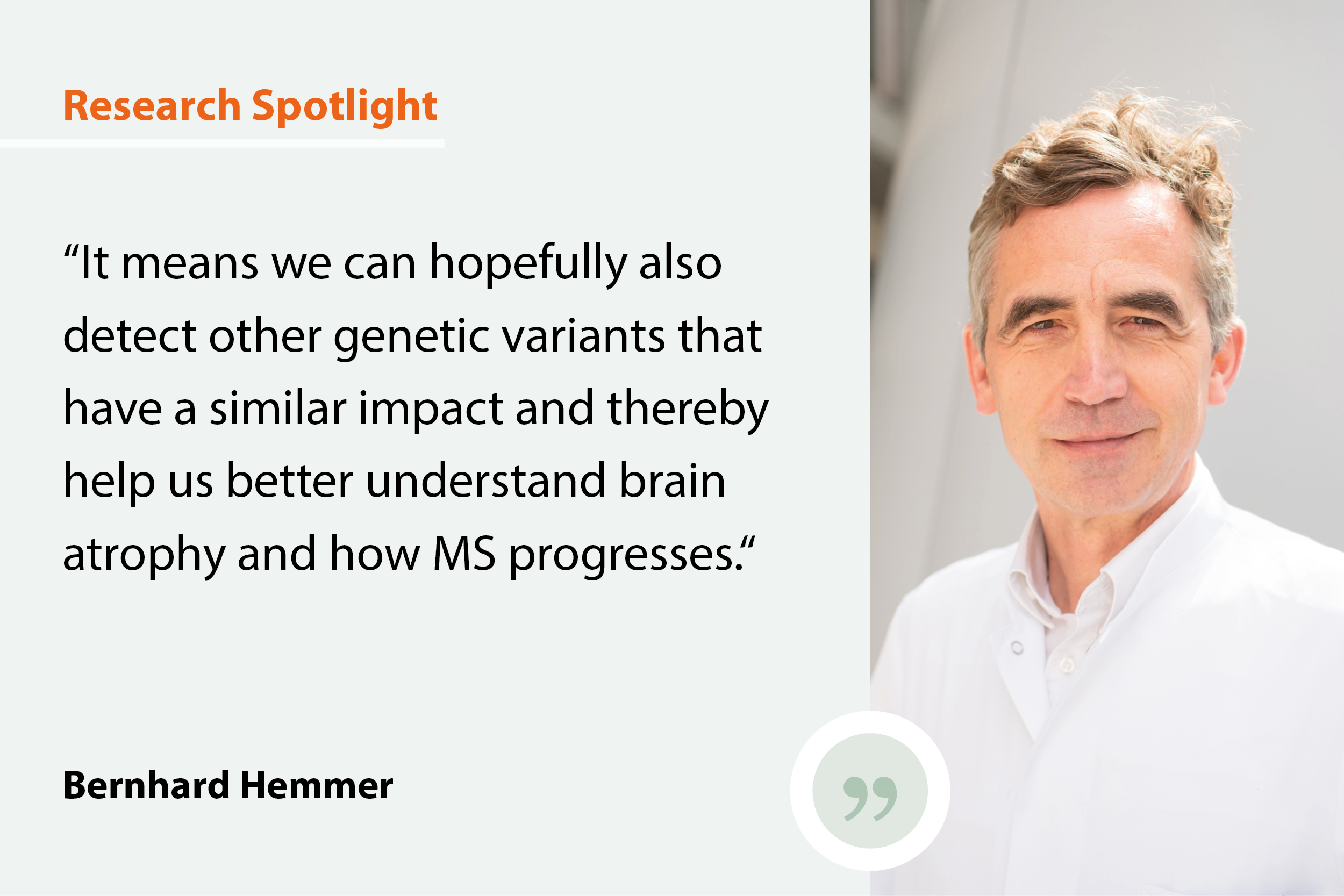
Our results illustrate that it is possible to establish a connection between genetic variants and how MS progresses by looking at MRI scans of the brain. It means we can hopefully also detect other genetic variants that have a similar impact and thereby help us better understand brain atrophy and how the disease progresses. This would open up new avenues for treatment. Furthermore, because this gene has a big effect on brain atrophy, we recommend using it to stratify for this genotype in clinical trials that include brain atrophy measurements.
Creating SyNergies
This research in SyNergy was led by the Hemmer and Mühlau teams at TUM supported by the SyNergy Macroscale Hub in cooperation with the Karolinska Institute in Stockholm in the context of the EU-funded Multiple MS consortium.